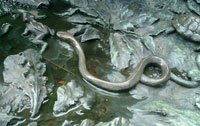
The oceans are full of our dumped plastic. Now it is found that freshwater lakes in subalpine locations are also contaminated with potentially hazardous plastics.
"The numbers of microplastic particles in sediment samples from Lake Garda were similar to those found in studies of marine beach sediments... From there they find their way into the food web...Next to mechanical impairments of swallowed plastics mistaken as food,
many plastic-associated chemicals have been shown to be carcinogenic,
endocrine-disrupting, or acutely toxic...Moreover, the polymers can adsorb toxic hydrophobic organic pollutants
and transport these compounds to otherwise less polluted habitats. Along
this line, plastic debris can act as vector for alien species and
diseases."
Source:
"Current Biolog (abstr.): Contamination of beach sediments of a subalpine lake with microplastic particles (pdf)
Images:
Lesser, Ury, Lake Garda with Monte Baldo
Showing posts with label anti_products. Show all posts
8.10.13
21.10.08
Leatherback Turtles out of a Habitat
For 100 million years the giant leatherback turtle (Dermochelyidae) swam in the warm and open oceans and sought to lay its eggs on a beach. It can get up to 3m long, can weigh up to 550 to 1,545 pounds (250-700 kg). The dinosaurs, came and went, but the largest living sea turtle continued on its long migration paths. One has been recorded swimming 20,000-kilometers (13,000-miles), from Indonesia to the U.S. looking for food. It loves eating jellyfish and other marine invertebrates. The the human species expanded and robbed it of all of its habitat.The Beaches ashore - no place to nest
- Beachfront developments, infrastructure and the activities of people destroy their habitat
- SUVs on beaches damage the eggs and light pollution disorients the hatchling orientation.
- Poaching turtles, eggs, leather or oil or commercializing the 'out-door zoo' is devastating
- Nesting beaches are disappearing through human caused global warming-induced sea level rises and cyclone destruction.
At the Ocean of foreshore - a dangerous place to be
- It becomes bycatch/bykill through ineffective fishing activities (longline and gillnet, crab pots and trawls)( "An estimated 50 000 leatherback turtles were likely killed incidentally by the pelagic longline fishery in 2000".)
- It gets eaten as meat or used as an aphrodisiac to boost the human population
- It gets entangled or injured in the marine plastic debris form the fishing industry (lines, fishing hooks, nets, ropes, floats or traps)
- It eats the plastic litter (especially plastic bags, as they look like a jelly under water) and dies.
- Boats and ships strike it and cut up the soft 'shell' with sharp propellers and anchors contributed to the mortality of the turtle.
- Pollution and pathogenic bugs (sewage) dumped into the ocean impact on the health of the turtle
- Urban shark nets trap turtles
- Deliberate acts of cruelty by human beings
- Sea grass depletion and reduced water quality
- In Baja California, Mexico," almost 3,000 sea turtles were found dead along a 27-mile stretch of coast during a five-year period from 2003 to 2007."
- "Leatherback sea turtles in the Pacific Ocean have declined by more than 90% over the past three decades as a result of drowning in industrial longline and gillnet fisheries targeting swordfish, sharks, and tunas."
- "Nesting in the Pacific (principally Japan and Australia) has declined by more than 90 percent over the past 25 years."
To reduce the risks for the sea turtle in "areas of highest risk/interaction with fisheries" 'safe swimways' are to be created. "The IUCN is urging nations to protect the leatherback turtle fr
om the world's industrial fisheries by identifying and creating marine protected areas along the Pacific leatherback's migratory routes. " It is to be seen what coastal habitat is put aside for the giant to reproduce and not hit the extinction vortex.A giant jelly bloom in a dead sea is sure to be left behind without the jelly eater. "If current trends continue, Pacific leatherbacks are predicted to go extinct within the next few decades...Now it's time to turn the high-tech science into political will and conservation action for critically endangered leatherbacks."
Images:
1. Part of Chelonia, E.Haeckel via Wikipedia
2. Discomedusa, plate 8, E.Haeckel via Zeno
Links:
SWOT Report, The State of the World's Sea Turtles
As a Threatened Species, NSW
Conservation Status, gov.au
Tagging (attaching huge radio transmitters on their backs) to hopefully go beyond the gathering of hard 'census' data.
How NOT to eat turtle as a bycatch/bykill
Boat strike and entanglement, Queensland.gov.au.
Updates:
- In the name of conservation, 'hard data' has to be gathered on the species to be protected. Previously animals had to be cut up, stuffed and staged in dusty museums. The mode of the day is to tag them or 'observe them in captivity'. So it is that the 100 million years survivor, potentially making it to the size of a small car is serving science today. The leatherback is being kept for 2 years in captivity with a rubber harness to "generated new information crucial for the conservation of the critically endangered species." On the human-wildlife interface, it is only the 'wild-life' that serves as object to be managed. The anthropogenic values and impacts are not on the agenda. The human can continue to roam and erase the other species unhindered in their habitat. A 'blind spot' of 'science' ?
Howard, Peter, The Beast Within: An Exploration of Australian Constructions of Wildlife, Griffith University, 2007
Soft Rubber Harness Enables Researchers To Study Leatherback Turtles In Captivity For Years. University of British Columbia (2008, November 1) ScienceDaily.
16.4.07
Toxic waste from Australia to Germany
The once prestine bay in Sydney, called Botany where British colonialisation started off, habours highly toxic waste form the industrial age. To 'keep Australia clean and beautiful', they are planning to off-shore their industrial waste to Germany.“Orica Australia is proposing to export 22,000 tonnes of highly toxic hexachlorobenzene (HCB) waste to Germany. The waste is supposed to be incinerated in Leverkusen, Dormagen, Herten and Brunsbuettel. Two of the incinerators are run by the Chemical company Bayer.” “Orica, the $5.4 billion parent company of Dulux, Cabot's, Selleys, Yates and Thrive, and the world's biggest maker of explosives, owns the waste, and says it cannot be properly destroyed in Australia.“
Hexachlorobenzene (HCB)
Petition against in Germany, Bund-N.R.W.
Image: Graffiti, Berlin
3.4.07
Visualising mass consumption
The photographic art of Chris Jordan depicts Grand Canyons of anti-products heaped up. 'Intolerable Beauty' is a documentation of (American) mass consumption. Fictions of certainty are dislodged in 'Kartina's Wake'. Worth viewing.
Subscribe to:
Posts (Atom)